
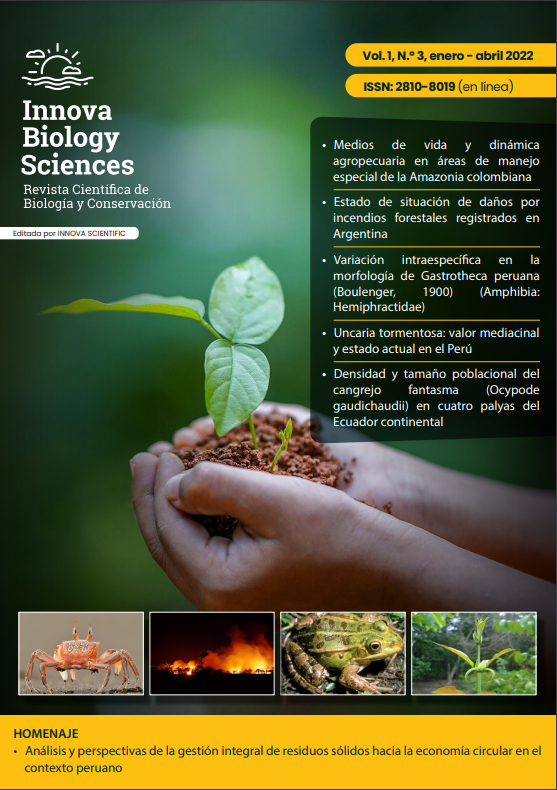
Livelihoods and agricultural dynamics in special management areas of the Colombian Amazon
DOI:
https://doi.org/10.58720/ibs.v2i1.32Keywords:
Rural families, Capital framework, Rurality, Productive system, Food securityAbstract
The characterization of management practices is the first step in the reconversion of increasingly sustainable production systems. However, sustainability is not only about the production model, but also about people. Although there are characterization methodologies based on sustainability indicators, there is a lack of approaches focused on the family and how it overcomes adversities. The research objective was to characterize the agricultural production systems in the Caquetá Soil and
Water Conservation District through the livelihoods approach and the community capital framework. The research contemplated the use of qualitative and quantitative tools to understand the agricultural dynamics in a case study. A semi-structured interview was applied to 141 families and a market survey questionnaire was applied to 32 points of sale. Livelihood strategies, capital endowment and level of food security were identified in the most dynamic agricultural and livestock farming areas. Fifty-five products derived from agricultural activities were identified, 40 from agriculture and 15 from livestock. At the landscape level, the mountains and the Amazonian foothills were the areas of greatest agricultural activity. The main livelihoods of the families are linked to the production of pasture, cocoa, coffee, sugar cane and bananas. To the extent that livelihoods are diversified, there is progress in improving the food security of the families, as well as in the economic sustainability and
integrality of production on the farms.
Downloads
Downloads
Published
How to Cite
Issue
Section
License
Copyright (c) 2022 Innova Biology Sciences

This work is licensed under a Creative Commons Attribution-NonCommercial-ShareAlike 4.0 International License.