
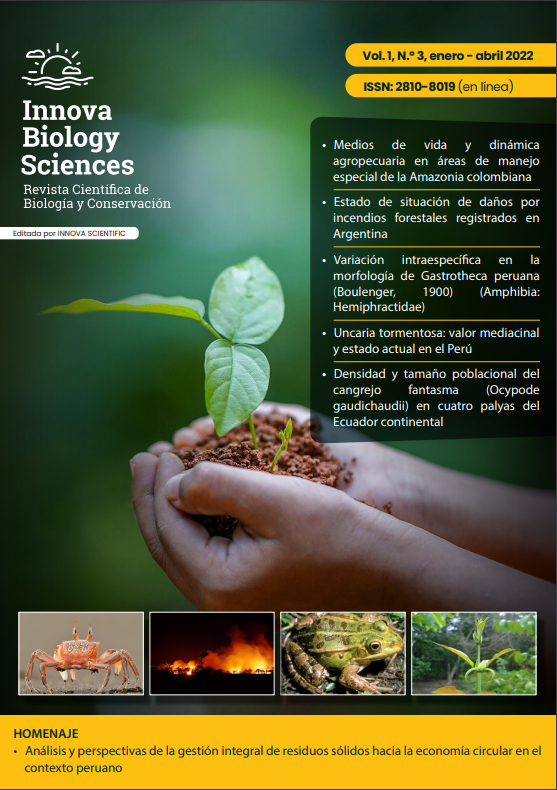
Intraspecific variation in the morphology of gastrotheca peruana (boulenger, 1900) (amphibia: hemiphractidae)
DOI:
https://doi.org/10.58720/ibs.v2i1.35Keywords:
Andes, Gastrotheca, Morphometry, Peru, Marsupial frogAbstract
Amphibians tend to have a conserved morphology, so morphometric studies have revealed the divergence of species. In Peru, controversy has arisen over the identity of some species of marsupial frogs of the genus Gastrotheca. Therefore, in the present work, it was established as an objective to review the taxonomic status of the Peruvian marsupial frog Gastrotheca (Boulenger 1900) using morphometric evidence. The results of this evidence support the hypothesis that Gastrotheca peruana sensu lato represents two lineages at the specific level based on the mitochondrial 16S rRNA gene. Also, MANOVA and Hotelling’s T2 statistical tests presented two morphologically different groups (p-value < 0.05); furthermore, the first two principal components (PCA) show substantial overlap of two candidate species. However, from a morphometric approach, it was
observed that Gastrotheca dissimilis with its positive and negative values of PCA1 and PCA2 tends to be distributed separately from Gastrotheca peruana sensu stricto; and the discriminant analysis showed 84.5 % of the cases correctly classified. Finally, it was found that G. peruana sensu stricto is restricted to the populations of the departments of Ancash, Lima, Pasco and Junín, and G. dissimilis, to the populations of La Libertad and Cajamarca.
Downloads
Downloads
Published
How to Cite
Issue
Section
License
Copyright (c) 2022 Innova Biology Sciences

This work is licensed under a Creative Commons Attribution-NonCommercial-ShareAlike 4.0 International License.