
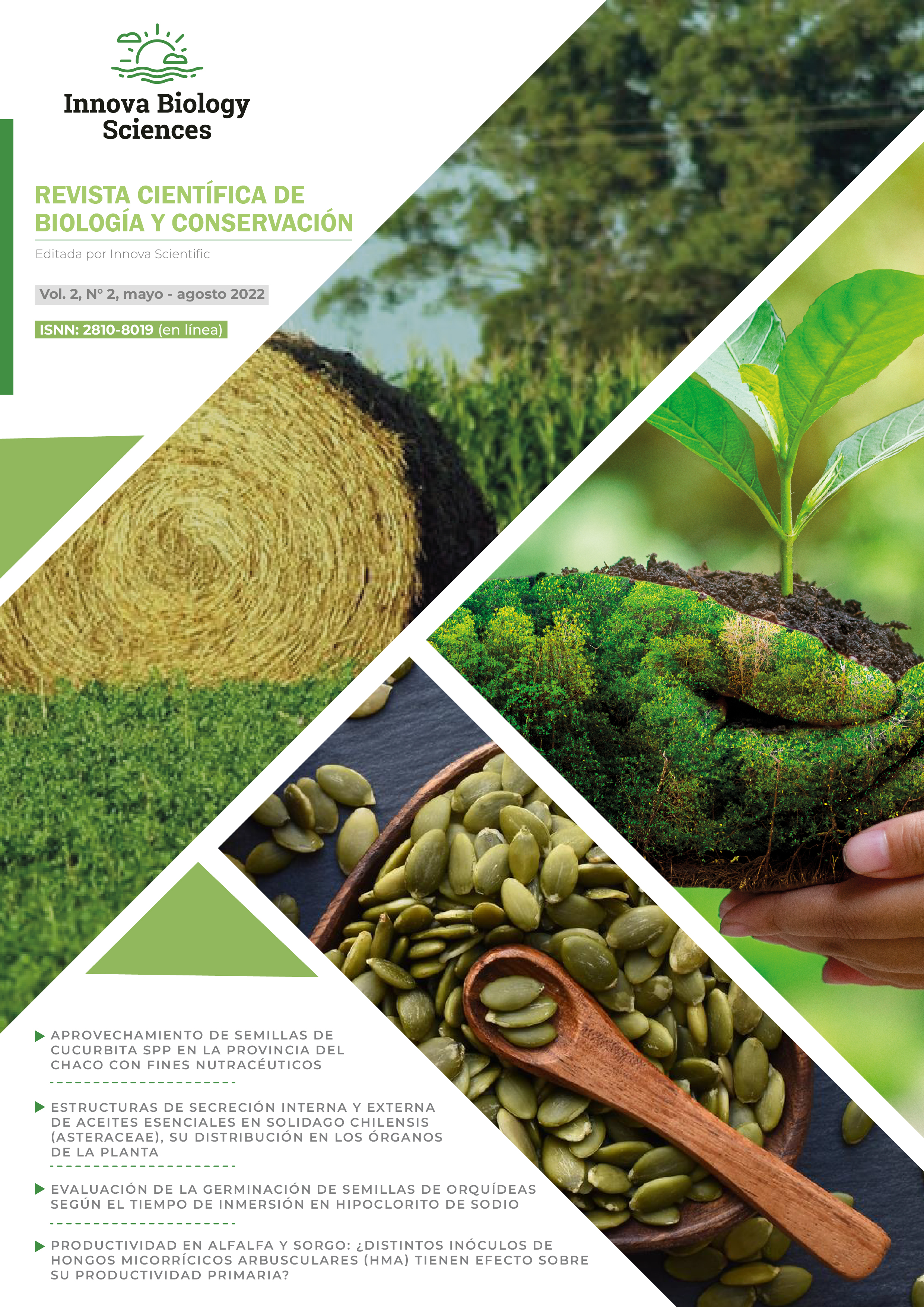
Use of Cucurbita spp seeds in the province of Chaco, Argentina for nutraceutical purposes
DOI:
https://doi.org/10.58720/ibs.v2i2.41Keywords:
Lomas de Lima, Problem, Urbanization, Contamination, Overgrazing, Civil SocietyAbstract
The pumpkin is a herbaceous plant, whose pulp is used for human consumption and its seeds are discarded, however, they have nutrients that are not used. The objective of this work is to carry out the botanical and chemical characterization of the crude drug from seeds of Cucurbita spp. Three varieties were compared: C. mixta Pangalo (striped pumpkin), C. moschata (Duchesne ex Lam.) Duchesne ex Poir. (koreanito) and, C. maxima Duchesne (lead pumpkin). The results obtained from the macroscopic visual examination were: length from 1.5 mm ± 0.1 to 1.9 mm ± 0.1; width of 0.8 mm ± 0.1 to 1.2 mm ± 0.1 and thickness of 0.2 mm ± 0.01 to 0.4 mm ± 0. Photochemical screening in the aqueous and alcoholic extracts studied revealed the presence of flavonoids, reducing sugars and amino acids. Regarding the pharmacognostic parameters: humidity from 4.68% ± 0.25 to 7.10% ± 0.74; ash from 3.87% ± 0.75 to 5.02% ± 0.68; insoluble ash 0.20% ± 0.13; crude fiber 1,768%. The protein content of the studied seeds (n=3) varied between: 29.79% ± 0.66 and 39.56% ± 0.78 in dry mass (d.m). The mineral composition was determined by Atomic Emission Spectroscopy (ICP-OES). Based on the Reference Daily Intake (RDI) the contribution of the major essential elements was significant, being Mg > P > K > Ca > Na and, among the minor elements, Mn, Cu, Fe and Zn. These studied characteristics show the valuable nutritional potential of Cucurbita spp.
Downloads
References
REFERENCIAS BIBLIOGRÁFICAS:
• Abreu Payrol, J., Saborido Martín, L., Suárez Pérez, E., Delgado Castillo, R., & Miranda Martínez, M. (2001). Estudio Farmacognóstico de la droga cruda de la semilla de calabaza (Cucurbita SPP). Revista Cubana de Farmacia, 35(3), 199-202.
• Akwaowo, E. U., Ndon, B. A., & Etuk, E. U. (2000). Minerals and antinutrients in fluted pumpkin (Telfairia occidentalis Hook f.). Food chemistry, 70(2), 235-240.
• American Oil Chemists Society, Official Methods and Recommended Practices of the American Oil Chemists’ Society (AOAC), Ed. Firestone, Champaign, Illinois, 2002.
• Artica, L., Baquerizo, M., Rosales, A., & Rodríguez, G. (2016). Aprovechamiento de semillas de cucúrbita ficifolia y cucúrbita máxima para la extracción de aceite y uso en la industria alimentaria. Prospectiva Universitaria, 13(1), 66-74.
• Bokova NA, Samylina IA, Baratova LA. (1982) Phytochemical study of the seeds of the squash. Farmatsiya 31(2):17-8.
• Caili, FU, Huan, S. y Quanhong, LI (2006). Una revisión de las actividades farmacológicas y tecnologías de utilización de la calabaza. Alimentos vegetales para la nutrición humana , 61 (2), 70-77.
• Dominguez, Xorge A. (1973). Métodos de Investigación fitoquímica. Ed Limusa S.A. ed. 4ª reimpresión (1985)
• Farmacopea Argentina Séptima ed. Página web en línea: Acceso: 15/11/2014. http://www.anmat.gov.ar/webanmat/fna/pfds/Libro_Primero.pdf.
• Jeffrey, C. (1990). Appendix. An outline classification of the Cucurbitaceae. Págs. 3- 9. Biology and utilization of the Cucurbitaceae. Cornell University Press. Ithaca, Nueva York.
• Matissek R, Schenepel F, Steiner G. (2000). Análisis de los alimentos. Zaragoza, España: Editorial Acriba S.A.; p. 44-54.
• Rodríguez, R. A., Valdés, M. P., & Ortiz, S. (2018). Características agronómicas y calidad nutricional de los frutos y semillas de zapallo Cucurbita sp. Revista colombiana de ciencia animal recia, 10(1), 86-97.
• Schenkel, E., Duez, P., & Hanocq, M. (1992). Stereoselective determination of cucurbitine in Cucurbita spp. seeds by gas chromatography and gas chromatography—mass spectrometry. Journal of Chromatography A, 625(2), 289-298.
Published
How to Cite
Issue
Section
License
Copyright (c) 2022 Innova Biology Sciences

This work is licensed under a Creative Commons Attribution-NonCommercial-NoDerivatives 4.0 International License.